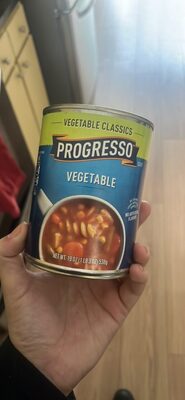
Yes, you can.
No ingredients incompatible with a halal diet were found.
Automated check based on Open Food Facts label data. Not medical advice. Always check the package.
Spotted an error? Tell us and we'll fix it.On the label
What we checked
This product on every diet
EatCheck is a free, community-supported tool. If this result helped you stay safe, consider supporting our server costs.
Nutrition facts (per 100g)
Per 100 g this product is low in saturated fat, low in sugars. Bands follow the UK front-of-pack guide: sugars high at 22.5 g or more and low at 5 g or less; salt high at 1.5 g or more and low at 0.3 g or less; saturated fat high at 5 g or more and low at 1.5 g or less. This describes the label, it is not dietary advice.
Processing level: NOVA group 4, ultra-processed foods. NOVA classification, from the label data.
Ingredients (original text)
water, tomato puree (water, tomato paste), carrots, celery, corn, green beans, tomatoes, potatoes, pasta (wheat flour, semolina, dried egg white), dried peas, carrot puree, hydrolyzed corn protein, salt, modified food starch, potassium chloride, red bell peppers, sugar, onion, tomato extract, spice, natural flavor, dried parsley, citric acid, calcium chloride, yeast extract,
Detailed analysis: Vegetable and the halal diet
Based on our analysis of the ingredients list, Vegetable appears to be compatible with a halal diet. Our automated system did not detect any ingredients that are typically restricted in this dietary lifestyle.
The ingredients provided are: water, tomato puree (water, tomato paste), carrots, celery, corn, green beans, tomatoes, potatoes, pasta (wheat flour, semolina, dried egg white), dried peas, carrot puree, hydrolyzed corn protein, salt, modified food starch, potassium chloride, red bell peppers, sugar, onion, tomato extract, spice, natural flavor, dried parsley, citric acid, calcium chloride, yeast extract,. It's always recommended to double-check the product packaging for the most current information, as formulations can change.
Nutritional profile
Vegetable contains 33.6 calories per 100g. It provides 1.3g of protein, 0.2g of fat, and 6.7g of carbohydrates (including 1.7g of sugar).
Note: This analysis is based on publicly available ingredient data. Always verify product labels and consult with healthcare professionals if you have specific dietary concerns or medical conditions.
People also checked
Frequently asked questions
Is Vegetable Halal?
Yes, Vegetable is considered Halal-friendly based on its ingredients. Our analysis did not detect any ingredients that are typically restricted in a Halal diet. Always double-check the label, as formulations can change.
Does Vegetable contain allergens?
Always check the packaging for the most current allergen information. The ingredients list we analyzed includes: water, tomato puree (water, tomato paste), carrots, celery, corn, green beans, tomatoes, potatoes, pasta (wheat flour, semolina, dried egg white), dri...
What are the nutritional facts of Vegetable?
Vegetable contains 33.6 calories per 100g, with 1.3g of protein, 6.7g of carbohydrates, and 0.2g of fat.
How much sugar is in Vegetable?
Vegetable lists 1.7 g of sugar per 100 g, which counts as low in sugar under the UK front-of-pack guide (5 g or less per 100 g).
Is Vegetable ultra-processed?
By the NOVA classification in its label data, Vegetable is in group 4, ultra-processed foods.
Can I eat Vegetable on a Halal diet?
Yes, based on our ingredient analysis, Vegetable appears to be suitable for a Halal diet. However, always verify the product label as formulations can change.